Rhythm-game history / Historical analysis
Guitar Hero: frets and strumming divide the performance
Guitar Hero pairs held fret buttons with a strum bar played to the beat. One hand chooses the frets while the other strums, turning the input sequence into a guitarist's performance on stage.
Article summary
- Map fret-button colors to screen lanes.
- Combine them with strumming at the notes.
- Learn to coordinate frets and strumming with the game's signals.
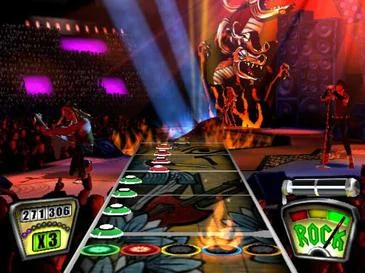
Guitar Hero · 2005 game screenshot
Five colored fret indicators sit on lanes shaped like a guitar neck. Foreground notes convey actions; the background stage and performers establish the concert setting.
Image credit: game by RedOctane / Harmonix · Image archive: Wikipedia · Source page ↗ · Original image ↗


Basic controls
- Hold the fret button matching the note's color.
- Operate the strum bar when the note reaches the judgment position.
- Keep the required fret held for sustained notes.
Combine colored buttons with strumming
Fret buttons map to lanes; the strum supplies the timed action. Holding with one hand and strumming with the other creates a different challenge from pressing five buttons. The controller gives each hand a defined role.
The 2005 game and a developer retrospective
A Harmonix developer's retrospective records Guitar Hero as a 2005 project and describes early production and the transition to Rock Band. It provides context for expanding an individual's guitar role into a band's roles.
Controls and features at a glance
| Element | What the player does | Play characteristic |
|---|---|---|
| Fret buttons | Hold the corresponding colored button | Select which note to play |
| Strum bar | Strum to the beat | Execute input timing |
| Stage screen | Show progression and performance together | Involvement in a performing role |
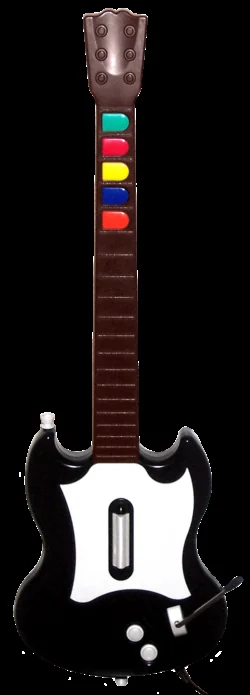
Guitar Hero · Guitar-controller photo
A guitar-shaped device with colored fret buttons and a strum bar. Holding and strumming are assigned to separate hands.
Image credit: photograph provided through Wikimedia Commons · See the individual file's rights statement · Source page ↗ · Original image ↗

Playing a role and mastering the controls
The guitar-shaped controller divides the hands' roles to convey participation in music. Mastery means matching frets and strums to game cues. Playing a real guitar involves its own techniques, including fingering and tone production, and a separate learning process.
Responses supporting the character's role
The same two buttons suggest different actions when presented as left/right choices or as two fists. Examine how the rules and feedback deliver the role that the controller or character appearance promises.
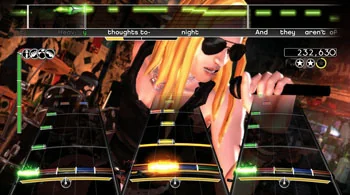
Rock Band · 2007 game screenshot
Vocal indicators above and instrument lanes below share one performance screen. Participants progress through the same song while reading different signals and using different controllers.
Image credit: game by Harmonix / MTV Games / Electronic Arts · Image archive: Wikipedia · Source page ↗ · Original image ↗


Comparison with Rock Band
Rock Band adds other instrumental parts around the guitar role within the same song. Compared with Guitar Hero's controller, the ensemble screen shows how an individual's task joins shared progress. Explain stage atmosphere alongside the separate rules for scoring inputs.
Sources & scope
A Harmonix retrospective informs the account of the 2005 game's production and guitar-shaped inputs, focusing on fret and strum roles.