Research and analysis / Reading research
MDA: connecting game rules and player experience
A rule change reaches the player through what happens during play. This guide uses a timing-window example to connect MDA's three categories, then develops alternative adjustments and a way to evaluate one intended experience.
Article summary
- Separate calculated rule outcomes from hypotheses about responses.
- Read behavioral records alongside players' accounts of their experience.
- Develop several tuning candidates from the intended experience.

Crypt of the NecroDancer · Developer's 2015 announcement screenshot
A game screen showing movement and enemy behavior tied to the beat. Observations and player responses are needed to assess the resulting experience.
Image credit: Brace Yourself Games / PlayStation.Blog · Source page ↗ · Original image ↗

Trace a changed rule through to play experience
What might players do and feel after a timing window narrows? MDA connects the implemented rules, interactions during play and intended experience. Name each layer, then use observation to investigate the links between them.
Hunicke, LeBlanc and Zubek explain that developers and players approach this connection from different directions. Developers adjust rules; players experience the running game. The framework can also work backward from intended experience to potential adjustments.
Related primary sources: Hunicke·LeBlanc·Zubek · MDA, pp.2~4 ↗
Record different evidence in the three categories
Mechanics covers the game's data, algorithms and rules. Dynamics covers interactions between the running system and the player. Aesthetics concerns the intended player experience. To investigate that experience, keep participants' explanations with the circumstances in which they gave them.
The original example narrows a hit window from ±80 ms to ±40 ms. The same +50 ms input succeeds in the first condition and fails in the second. This is a numerical outcome. Pressing earlier, memorizing the section and retrying are possible subsequent behaviors to observe.
Related primary sources: Hunicke·LeBlanc·Zubek · MDA, pp.2~4 ↗
Three layers in the judgment-window example
| Layer | Example | Evidence status |
|---|---|---|
| Mechanics | ±80→±40ms | Changed setting |
| Dynamics | Press earlier or stop pressing | Hypothesis to observe |
| Aesthetics | Willingness to retry under tension | Experience to investigate with the participant |

CAT BEAT : Wake the Beat · Development screenshot
The VS screenshot shows targets, inputs and results. The framework below sets out how to investigate players' feelings about tension and fairness through further evidence.
Image credit: Level Up Today · Source page ↗ · Original image ↗

Keep several hypotheses for one rule
Consider both the hypothesis that a narrower window prompts closer listening and the hypothesis that players stop pressing after a miss. Label both as predictions before testing. Define the intended experience as understanding the failure and wanting to retry despite tension.
Change conditions within the same task, song and device. Record input timestamps, pauses, retries and speech. Ask participants about tension and fairness, and interpret behavioral counts alongside those responses.
Fix the rule; leave the response as a hypothesis
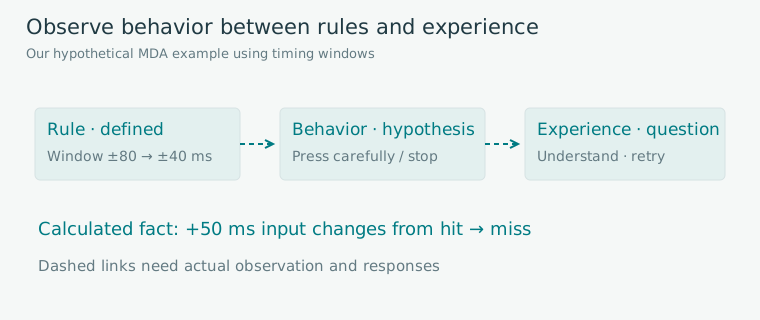
Editorial diagram · The ±80→±40 ms change and +50 ms input are original numerical examples. Dashed connections remain to be observed.
Columns: rule → possible behavior → experience question. Solid lines=calculated outcome; dashed lines=hypotheses to test.
On smaller screens, scroll the diagram horizontally. Enlarge diagram ↗
Values and sequence shown in the diagram
- +50 ms: hit → miss
- Possible behavior: press attentively / stop pressing
- Experience question: is the failure understood, and does the player want to retry?
Read a real example of actions tied to rhythm
The developers' introduction to Crypt of the NecroDancer explains how player movement and enemy actions follow musical beats. Players must choose a direction while keeping time, making it possible to examine the rules alongside decisions made during play.
Developing observation questions about attention, anticipation and tension is an editorial application of MDA. Separate the creators' feature descriptions from newly proposed experience hypotheses. CAT BEAT's versus screenshot similarly provides evidence of input and result layout.
Related primary sources: Developers · Introducing Crypt of the NecroDancer ↗
Compare alternatives for the same experience
Several changes could help players understand a miss and try again: add timing-error feedback while keeping the window fixed, increase lead time or simplify the opening patterns. For each candidate, specify the rule changed and the behavior expected.
Compare one changed condition at a time, or record why multiple conditions changed together. Improved feedback comprehension may also increase visual obstruction, so observe reading of the next target. Choose an option after gathering the records.
Three tuning candidates for one experience goal
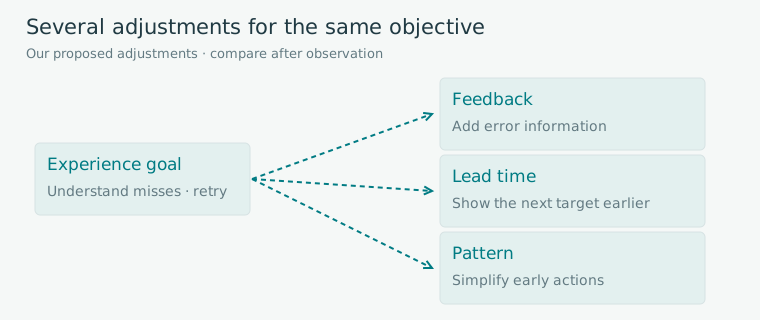
Editorial diagram · Original proposals aimed at understanding misses and retrying. Their relative value is assessed after observation.
Left: intended experience. Right: candidates for feedback, lead time and patterns.
On smaller screens, scroll the diagram horizontally. Enlarge diagram ↗
Values and sequence shown in the diagram
- Add error feedback
- Increase lead time
- Simplify early patterns
Separate facts, hypotheses and responses in the report
Keep separate fields for rule version, scored results, play behavior, participant comments, interpretation and proposed revision. A +50 ms miss is an event record; “I pressed a little early” is a participant's explanation. Comparing the two can help narrow the investigation.
An MDA-based conclusion states which objective was examined under which conditions. The figures and possible responses in this article are learning models; actual playtest outcomes are reported with execution records.
Evidence to keep distinct in the report
| Category | Fictional example | Supporting evidence |
|---|---|---|
| Rule | Window ±40 ms | Settings and version |
| Event | Input +50 ms: miss | Time, target and result |
| Action | Stop for 2 seconds after a miss | Observation record |
| Response | Statement that the reason was understood | Actual words spoken |
| Interpretation | Candidate feedback improvement | The evidence above and alternative comparisons |
Sources & scope
We read the categories, perspectives and tuning structure in the MDA paper, pp. 2–4, and the developers' NecroDancer introduction. The ±80→±40 ms change, possible behaviors and alternatives are original hypothetical models, presented separately from measured play responses.