Reading games / Reference games
Studying reference games through input and feedback
Studying a reference game starts with the cues players notice and the responses their actions produce. Recording controls and feedback under consistent headings helps identify useful design principles, including those shared by games in different genres.
Article summary
- Separate impressions from observations of actual behavior.
- Questions about anticipation, results and learning can be compared across genres.
- Disclose the operating relationship when presenting an in-house game.
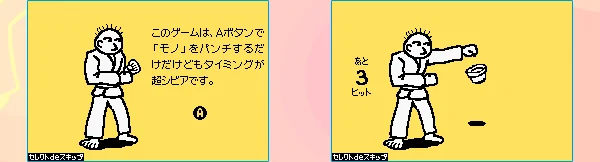
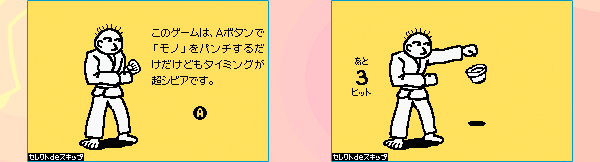
Rhythm Tengoku · Official Game Boy Advance guide
The official guide places Karate Man's instructions beside the game screen. Incoming objects and character movements signal when to act, rather than notes descending along separate lanes.
Image credit: Nintendo / J.P.ROOM · Source page ↗ · Original image ↗
Describe what makes a scene enjoyable through its actions
Look at the cues before an attack or input, the immediate response and the information that shapes the next decision. Recording controls and feedback together helps identify what makes an enjoyable scene work. Keep evidence from playing the game distinct from evidence in its official descriptions.
Rhythm Doctor's one-button controls
Rhythm Doctor's official website describes it as a one-button rhythm game. Keeping that button fixed makes it possible to examine how changing rhythmic expectations and input timing create different decisions. The game illustrates how a design can expand what players do without adding controls.
Observation questions for reference games
| Game | Feature to examine | Question to record |
|---|---|---|
| Rhythm Doctor | One-button rhythm in the official description | How decisions expand under the same control |
| Hollow Knight | Exploration and action in the official description | How danger and attack results are anticipated |
| Rhythm Tengoku | Ready cues and brief scenarios | What helps players anticipate the next moment |
| CAT BEAT | Several modes sharing left and right inputs | How timing, memory and target recognition differ |
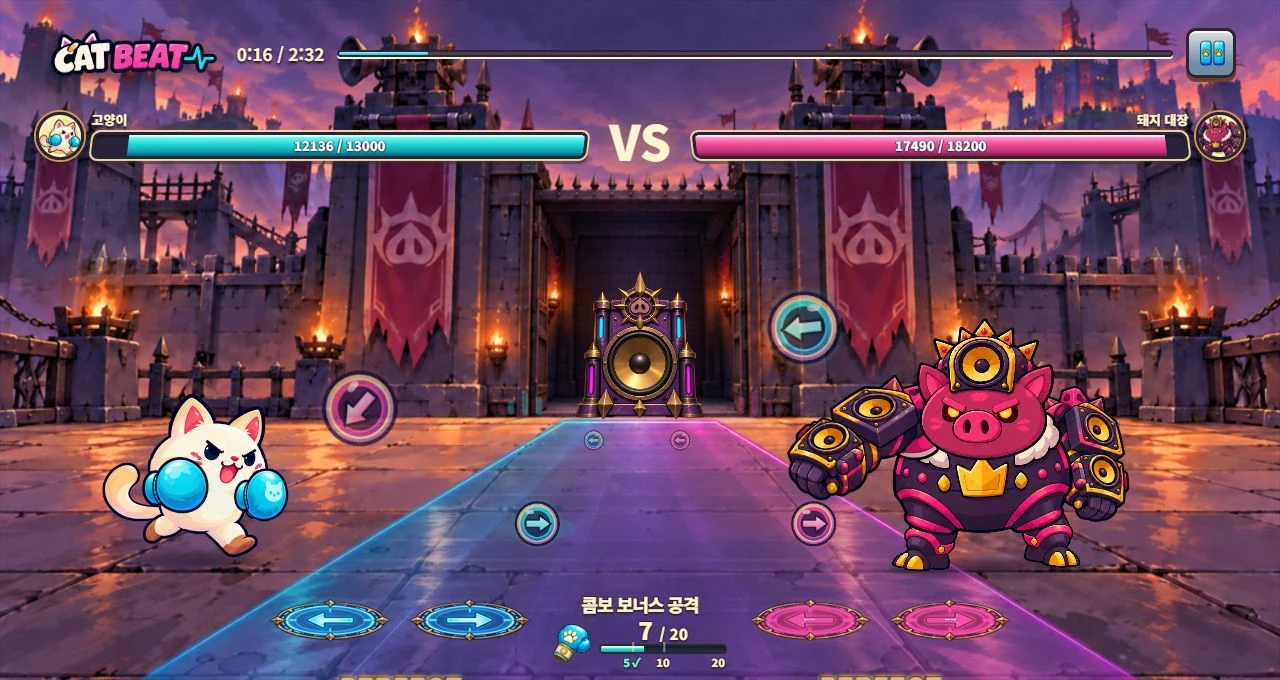
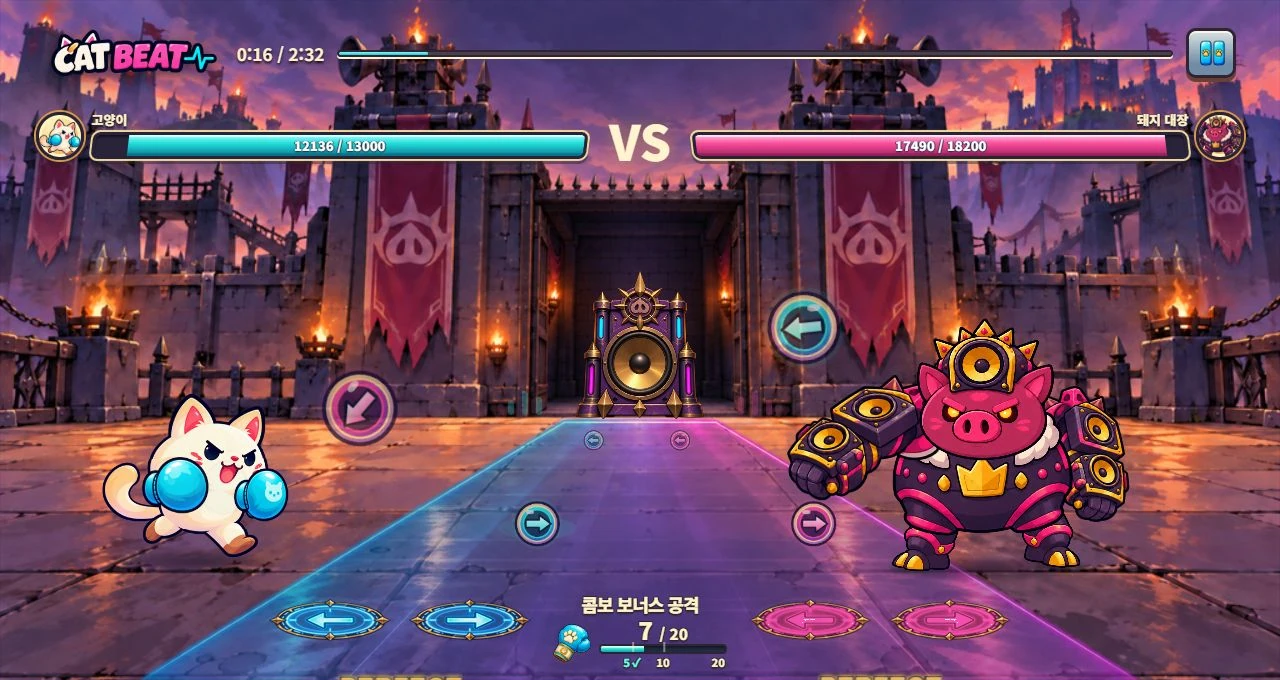
CAT BEAT : Wake the Beat · Development screenshot
An actual development screenshot of VS Boss mode. Players remember a demonstrated pattern and counterattack.
Image credit: Level Up Today · Source page ↗ · Original image ↗
Anticipation and feedback in Hollow Knight
Hollow Knight's official store page emphasizes exploration and action. Its pre-attack movements, follow-through, danger cues and spatial targets offer useful points of comparison with rhythm games. Study the roles those elements play while keeping the original game's presentation and assets separate.
Decisions across CAT BEAT's modes
Boxing emphasizes direction and timing, Cat's Day target recognition, and VS Boss pattern memory. This in-house example connects the same left and right inputs to different decisions in each mode.
Fields for comparison records
Use a common table for each game's name, evidence, controls, advance cues, input results and progression after mistakes. Record both what is relevant to the current design and what would need adapting. Comparing games with different control schemes helps narrow the features for a first version.
Sources & scope
Controls and feedback were analyzed using official descriptions of external games. CAT BEAT is in development at Level Up Today, the operator of this publication.