Developments / Technology news
W3C publishes a Web Audio API 1.1 Working Draft
W3C published a further Working Draft of Web Audio API 1.1 on September 22, 2026. Comparing it with the first 2024 draft reveals changes to the length definition. This article examines that change, the specification's audio-routing diagrams and the checks needed to test an implementation.
Article summary
- Read the September 2026 document alongside the first 2024 draft.
- Compare changes to whether length is required, its type and its default.
- Check adoption through a small working example and environment records.
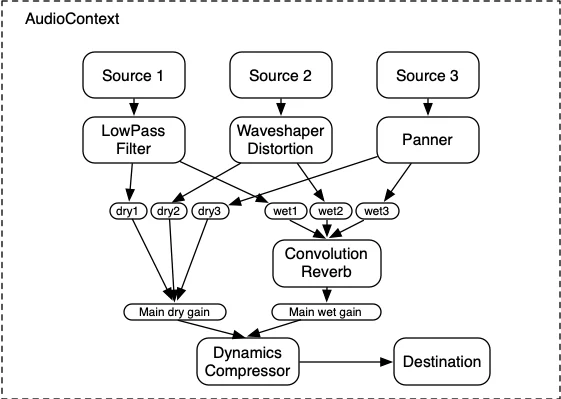
Web Audio API 1.1 · 2026-09-22 Working Draft
The official routing example shows sources passing through processing nodes and converging at the output. The IDL comparison table in the article explains changes between specification versions.
Image credit: W3C Web Audio Working Group · W3C Document License · Source page ↗ · Original image ↗ · Document license ↗

A new working draft follows the first 2024 publication
W3C published a Web Audio API 1.1 Working Draft on September 22, 2026, following the First Public Working Draft of November 5, 2024. Each version has a dated permanent URL containing its status and full text.
A Working Draft describes a specification under development. The comparison here covers changes to API definitions and document versions, followed by the work needed to test their implementation.
Related primary sources: W3C · 2026.09.22 Working Draft ↗ · W3C · 2024.11.05 First Public Working Draft ↗
The first public draft and a subsequent working draft
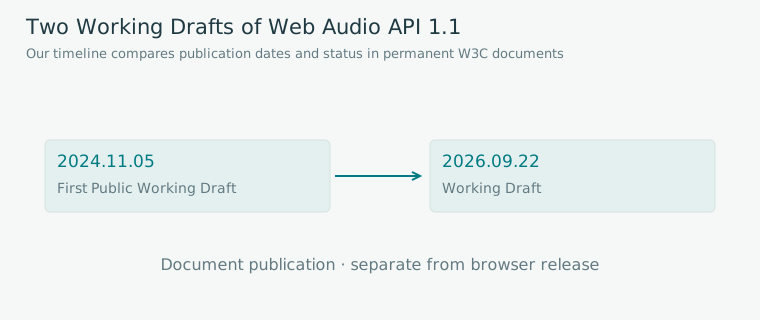
Editorial diagram · An original diagram of the publication dates and statuses of two permanent document versions.
Horizontal: 2024.11.05 → 2026.09.22. Markers indicate document publication, separately from browser releases.
On smaller screens, scroll the diagram horizontally. Enlarge diagram ↗
Values and sequence shown in the diagram
- 2024.11.05:First Public Working Draft
- 2026.09.22:Working Draft
What changed in the length definition
Comparing OfflineAudioContextOptions IDL shows length as a required unsigned long in 2024 and a nullable unsigned long defaulting to null in 2026. The requirement and permitted-value definitions have changed.
This is a change to the interface definition. To establish what happens when length is omitted or set to null, read the constructor and processing algorithms in that version, then test the target implementation. For a potential game feature, begin with a minimal executable example and an expected result.
Related primary sources: W3C · 2026.09.22 Working Draft ↗ · W3C · 2024.11.05 First Public Working Draft ↗
Evidence from document review to execution
| Stage | What to examine | Record |
|---|---|---|
| Document comparison | Definitions in both versions | Permanent URLs, sections and differences |
| Minimal example | Inputs, defaults and exceptions | Code and expected results |
| Execution environment | Creation, output and return from interruption | Browser, device and results |

CAT BEAT : Wake the Beat · Development screenshot
Music and input in a development build. The screenshot illustrates a game use case; support for the 2026 specification requires separate implementation tests.
Image credit: Level Up Today · Source page ↗ · Original image ↗

Definitions compared directly
| Item | 2024.11.05 | 2026.09.22 |
|---|---|---|
| OfflineAudioContextOptions.length | Required unsigned long | unsigned long? · Default null |
| renderSizeHint | Defined in the document | Defined in the document |
| renderQuantumSize | Defined in the document | Defined in the document |
Identify what changed and what carried over
The 2024 document already includes renderSizeHint and renderQuantumSize. A report on the 2026 draft needs to distinguish retained definitions from changes found in the comparison. Each property should be traced to its version before it is described as new.
Record both permanent URLs, section names and the definitions before and after each change. A claim about implementation support also needs browser versions, experimental settings and execution results. This article reports document changes; browser-support measurements remain separate work.
Related primary sources: W3C · 2026.09.22 Working Draft ↗ · W3C · 2024.11.05 First Public Working Draft ↗
What the routing illustration shows
The official figure depicts sources converging at the output after filters, gains, reverb and other processing. It explains audio flow. The original diagram below reduces this to a small structure: two sources, each with its own gain, feeding one output.
For a game, give background music and effects independently controllable audio paths, then test starting, stopping and resuming them. Check connections, scheduled times and output states against evidence for each.
Related primary sources: W3C · 2026.09.22 Working Draft ↗
Control two sources separately, then combine them at the output
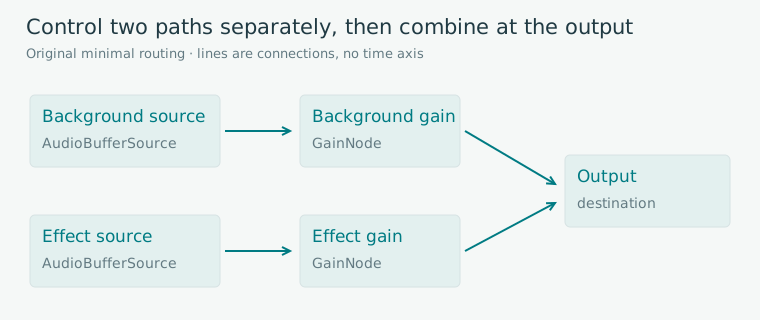
Editorial diagram · An original minimal path based on Web Audio connections.
Columns: source → gain → output. Solid lines indicate audio connections; there is no time axis.
On smaller screens, scroll the diagram horizontally. Enlarge diagram ↗
Values and sequence shown in the diagram
- Background source → background gain
- Effect source → effect gain
- Both gains → output
From reading the specification to running a test
Read the interface's inputs, defaults and exceptions, then build a minimal example. Check API availability, object creation, expected output and recovery after interruption. Clear success criteria help explain what a specification change means for a production decision.
Execution records should include the browser and version, operating system, output device and code version. Keep the document-review date separate from the execution-test date so later changes can be compared under the same conditions.
Keep a versioned record of technical changes
Record the publication date, document status, definitions compared and questions for game development together. Attribute definitions to the specification and identify our proposed applications separately.
The 2026 draft offers another version of Web Audio's definitions to examine. For production, select the features a project needs and test them in its target environment.
Sources & scope
Sources reviewed 2026.10.17: Status, OfflineAudioContextOptions IDL, renderSizeHint and renderQuantumSize in both permanent documents. Changes to the length requirement, type and default were confirmed. This is separate from testing a particular browser's implementation or output performance.